COPENHAGEN, Denmark (AP) — A territorial dispute between Denmark and Canada over a barren and uninhabited rock in the Arctic that has led to decades of friendly friction has come to an end, with the two countries agreeing to divide the tiny island between them.
A decades-old dispute between Denmark and Canada over a tiny, barren and uninhabited rock in the Arctic has come to an end.
Under the agreement, to be signed later Tuesday, a border will be drawn across the 1.3-square-kilometer (half-square-mile) Hans Island, in the waterway between the northwestern coast of the semi-autonomous Danish territory of Greenland and Canada’s Ellesmere Island. The rock has no mineral reserves.
“It sends a clear signal that it is possible to resolve border disputes … in a pragmatic and peaceful way, where the all parties become winners,” said Danish Foreign Minister Jeppe Kofod. He said it was “an important signal now that there is much war and unrest in the world.”
Canada and Denmark agreed in 1973 to create a border through Nares Strait, halfway between Greenland and Canada. But they were unable to agree which country would have sovereignty over Hans Island, which lies about 1,100 kilometers (684 miles) south of the North Pole. In the end, they decided to work out the question of ownership later.
In the following years, the territorial dispute — nicknamed the “whisky war” by media — raised its head multiple times.
In 1984, Denmark’s minister of Greenland affairs raised a Danish flag on the island, buried a bottle of Danish schnapps at the base of the flagpole and left a note saying, “Welcome to the Danish island.” Canadians then planted their own flag and left a bottle of Canadian brandy. Since then, the countries have in turns hoisted their flags and left bottles of various spirits in tit-for-tat moves.
In 2002, Nana Flensburg was part of a Danish military crew that stood on the cliff to perform a flag-raising ceremony. The Politiken newspaper on Tuesday quote her as saying in her diary that “among the stones in the cairns were lots of bottles, glasses, etc. with documents that informed about previous visits to the island.”
The agreement enters into force after the two countries’ internal procedures have been completed. In Denmark, the Parliament must first give its consent to the agreement.
AUSTIN, Texas (AP) — As public pressure mounts for more information on the deadly Uvalde school shooting, some are concerned that Texas officials will use a legal loophole to block records from being released — even to the victims’ families — once the case is closed.
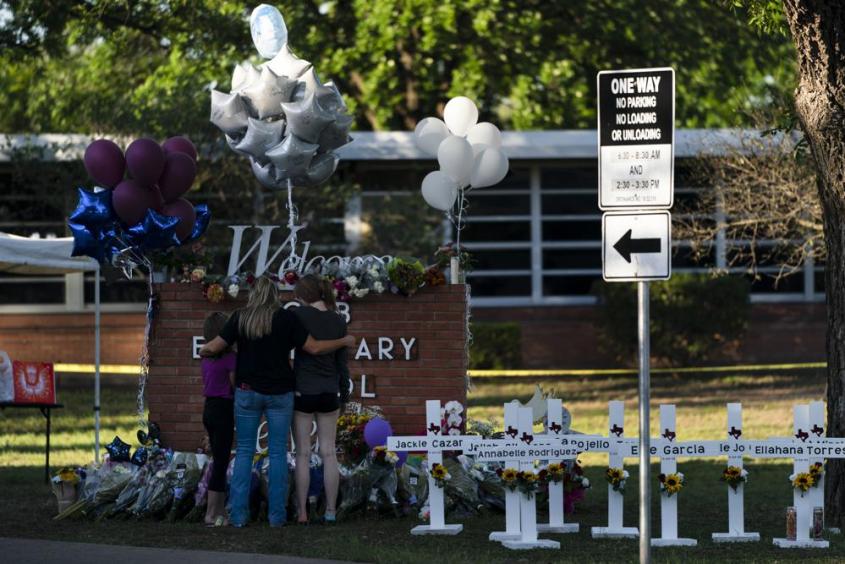
FILE – A Texas Department of Public Safety officer keeps watch on June 3, 2022, in Uvalde, Texas, near a memorial outside Robb Elementary School created to honor the victims killed in last a school shooting. As public pressure mounts for more information on the deadly Uvalde school shooting, some are concerned that Texas officials will use a legal loophole to block records from being released — even to the victims’ families — once the case is closed. (AP Photo/Eric Gay, File)
Since the May 24 shooting at a Texas elementary school that left 19 kids and two teachers dead, law enforcement officials have provided little or conflicting information, sometimes withdrawing statements hours after making them. State police have said some accounts were preliminary and may change as more witnesses are interviewed.
Officials have declined to release more details, citing the investigation. In a letter received Thursday by The Associated Press and other media outlets, a law firm representing the City of Uvalde asked for the Texas attorney general’s office to rule on records requested in relation to the shooting, citing 52 legal areas — including the section containing the loophole — that they believe exempt the records from being released. Amid the growing silence, lawyers and advocates for the victim’s families are beginning to fear they may never get the answers, that authorities will close the case and rely on the exception to the Texas Public Information law to block the release of any further information.
“They could make that decision; they shouldn’t have that choice,” said Democratic state Rep. Joe Moody of El Paso, who since 2017 has led several efforts to amend the loophole. “To understand what our government is doing should not be that difficult — and right now it is very difficult.”
The law’s exception protects information from being released in crimes for which no one has been convicted. The Texas Attorney General’s Office has ruled that it applies when a suspect is dead. Salvador Ramos, the 18-year-old man who police say was responsible for the mass killing at Robb Elementary School, was fatally shot by law enforcement.
The loophole was created in the 1990s to protect those wrongfully accused or whose cases were dismissed, according to Kelley Shannon, executive director of the Freedom of Information Foundation of Texas. “It is meant to protect the innocent,” Shannon said. But she said that in some cases “it is being used and misused in a way that was never intended.”
Following the shooting, Texas House of Representatives Speaker Dade Phelan, a Republican, took to Twitter to voice his continued support for closing the loophole during the Texas Legislature’s next session, which begins in January 2023.
“More than anything, the families of the Uvalde victims need honest answers and transparency,” Phelan tweeted. He said it would be “absolutely unconscionable” to deny information based on the “dead suspect loophole.”
Charley Wilkison, executive director of the Combined Law Enforcement Associations of Texas, said the organization was opposed and “will always be opposed” to a loophole amendment proposed in previous years that he said would have allowed the release of records pertaining to law enforcement officers, even those falsely accused of wrongdoing. He said that would negatively affect the officers’ ability to keep working. But Wilkison said he would be willing to participate in future discussions in an attempt to find a middle ground.
Public focus in the Uvalde shooting has been on school district police Chief Pete Arredondo. Steven McCraw, head of the Texas Department of Public Safety, said recently that Arredondo believed the active shooting had turned into a hostage situation, and that he made the “wrong decision” to not order officers to breach the classroom more quickly to confront the gunman.
The New York Times reported Thursday that it obtained documents showing police waited for protective equipment as they delayed entering the campus, even as they became aware that some victims needed medical treatment.
If efforts to amend the public information loophole fail and law enforcement continues to refuse to release information, families could turn to any involved federal agencies. In one case in Mesquite, Texas, the parents of an 18-year-old who died after being arrested received records from federal authorities showing that police had used more force against their son than they had originally understood. The police had refused to turn over any information under the legal loophole.
“If someone dies in police custody, this is when we would want to open all of our records,” the father, Robert Dyer, said as he testified before the legislature in 2019 in favor of amending the legal exception.
Military officials and law enforcement said Robinson pulled a gun and shot himself as police were trying to make contact with him. But local police wouldn’t allow Vanessa Guillen’s family to view the officers’ body camera footage of the confrontation because the suspect hadn’t been convicted, Mayra Guillen said.
“We were honestly just trying to receive closure and see if what was being said was true,” Guillen said. “It is only right to have these records be public to some extent. It is so hard to tell whether there will be justice or not.”
HELENA, Mont. (AP) — Raging floodwaters that pulled houses into rivers and forced rescues by air and boat began to slowly recede Tuesday across the Yellowstone region, leaving tourists and others stranded after roads and bridges were knocked out by torrential rains that swelled waterways to record levels.
The flooding across parts of southern Montana and northern Wyoming forced the indefinite closure of Yellowstone National Park just as a summer tourist season that draws millions of visitors annually was ramping up.
In this photo provided by Sam Glotzbach, the fast-rushing Yellowstone River flooded what appeared to be a small boathouse in Gardiner, Mont., on Monday, June 13, 2022, just north of Yellowstone National Park. (Sam Glotzbach via AP)
Just north of the park, hundreds of people remained isolated after the Yellowstone River and its tributaries washed away the only roadways in and out of the area.
Near Gardiner, Montana, campground manager Marshall Haley said some people had evacuated before the roads washed out after being warned that the river was rising. But others stayed behind and now couldn’t leave, he said. There was no word on when the roads could be repaired and re-opened.
“We’re on an island so to speak,” said Haley. “Most of the motels were full, and the store’s going to run out of food pretty soon probably because no truck can get down here.”
The towns of Cooke City and Silvergate, just east of the park, were also isolated by floodwaters.
Numerous homes and other structures were destroyed, but there were no immediate reports of injuries or fatalities.
Heavy rain on top of melting mountain snow pushed the Yellowstone, Stillwater and Clarks Fork rivers to record levels Monday, according to the National Weather Service.
Officials in Yellowstone and in several southern Montana counties were assessing damage from the storms that also triggered mudslides and rockslides. Montana Gov. Greg Gianforte declared a statewide disaster.
In Livingston, low-lying neighborhoods were evacuated and the city’s hospital was evacuated as a precaution after its driveway flooded.
It was unclear how many visitors to the region remained stranded or have been forced to leave Yellowstone, or how many people who live outside the park were rescued and evacuated.
Some of the worst damage happened in the northern part of the park and Yellowstone’s gateway communities in southern Montana. National Park Service photos of northern Yellowstone showed a mudslide, washed out bridges and roads undercut by churning floodwaters of the Gardner and Lamar rivers.
Officials in Park County, which includes Gardiner and Cooke City, said extensive flooding throughout the county had made drinking water unsafe in many areas.
The Montana National Guard said Monday it sent two helicopters to southern Montana to help with the evacuations.
In south-central Montana, flooding on the Stillwater River stranded 68 people at a campground. Stillwater County Emergency Services agencies and crews with the Stillwater Mine rescued people Monday from the Woodbine Campground by raft. Some roads in the area are closed because of flooding and residents have been evacuated.
“We will be assessing the loss of homes and structures when the waters recede,” the sheriff’s office said in a statement.
Cory Mottice, a meteorologist with the National Weather Service in Billings, Montana, said rain is not in the immediate forecast, and cooler temperatures will lessen the snowmelt in coming days.
“This is flooding that we’ve just never seen in our lifetimes before,” Mottice said.
Scientists say climate change is responsible for more intense and more frequent extreme events such as storms, droughts, floods and wildfires, although single weather events usually cannot be directly linked to climate change without extensive study.
The Yellowstone River at Corwin Springs crested at 13.88 feet (4.2 meters) Monday, higher than the previous record of 11.5 feet (3.5 meters) set in 1918, according the the National Weather Service.
At a cabin in Gardiner, Parker Manning got an up-close view of the water rising and the river bank sloughing off in the raging Yellowstone River floodwaters just outside his door.
“We started seeing entire trees floating down the river, debris,” Manning, who is from Terra Haute, Indiana, told The Associated Press. “Saw one crazy single kayaker coming down through, which was kind of insane.”
On Monday evening, Manning watched as the rushing waters undercut the opposite riverbank, causing a house to fall into the Yellowstone River and float away mostly intact.
Floodwaters inundated a street in Red Lodge, a Montana town of 2,100 that’s a popular jumping-off point for a scenic, winding route into the Yellowstone high country. Twenty-five miles (40 kilometers) to the northeast, in Joliet, Kristan Apodaca wiped away tears as she stood across the street from a washed-out bridge, The Billings Gazette reported.
The log cabin that belonged to her grandmother, who died in March, flooded, as did the park where Apodaca’s husband proposed.
“I am sixth-generation. This is our home,” she said. “That bridge I literally drove yesterday. My mom drove it at 3 a.m. before it was washed out.”
On Monday, Yellowstone officials evacuated the northern part of the park, where roads may remain impassable for a substantial length of time, park Superintendent Cam Sholly said in a statement.
But the flooding affected the rest of the park, too, with park officials warning of yet higher flooding and potential problems with water supplies and wastewater systems at developed areas.
The rains hit just as area hotels have filled up in recent weeks with summer tourists. More than 4 million visitors were tallied by the park last year. The wave of tourists doesn’t abate until fall and June is typically one of Yellowstone’s busiest months.
Yellowstone got 2.5 inches (6 centimeters) of rain Saturday, Sunday and into Monday. The Beartooth Mountains northeast of Yellowstone got as much as 4 inches (10 centimeters), according to the National Weather Service.
The flooding happened while other parts of the U.S. burned in hot and dry weather. More than 100 million Americans were being warned to stay indoors as a heat wave settles over states stretching through parts of the Gulf Coast to the Great Lakes and east to the Carolinas.
Associated Press writers Thomas Peipert in Denver, Mead Gruver in Fort Collins, Colorado, and Lisa Baumann in Bellingham, Washington, contributed to this report.
SAN ISIDRO DEL PALMAR, Mexico (AP) — Hurricane Agatha made history as the strongest hurricane ever recorded to come ashore in May during the eastern Pacific hurricane season, making landfall on a sparsely populated stretch of small beach towns and fishing villages in southern Mexico.
This satellite image made available by NOAA shows Hurricane Agatha off the Pacific coast of Oaxaca state, Mexico on Monday, May 30, 2022, at 8:30 a.m. EDT. (NOAA via AP)
The storm hit Oaxaca state Monday afternoon as a strong Category 2 hurricane with maximum sustained winds of 105 mph (165kph), then quickly lost power as it moved inland over the mountainous interior.
Remnants of Agatha were moving northeast Tuesday into Veracruz state, with sustained winds down to 30 mph (45 kph). The U.S. National Hurricane Center said the storm should dissipate by the evening, but warned that the system’s heavy rains still posed a threat of dangerous floods for Mexico’s southern states.
Oaxaca Gov. Alejandro Murat told local media that the state’s emergency services office had no reports of deaths. Several municipalities near the coast remained without power Tuesday and mudslides blocked a number of the state’s highways.
San Isidro del Palmar, only a couple miles inland from the coast, was swamped by the Tonameca river that flows through town.
Residents waded through neck-deep water to salvage what items they could from their homes, walking gingerly with piles of clothing atop their heads and religious figures in their arms.
Argeo Aquino, who had lived in the town his whole life, could recall only two other occasions when he saw such flooding.
“The houses are totally flooded, so they are getting everything out,” Aquino said Monday as he watched his neighbors. “There are stores, houses. More than anything else, we have to try to save all the good material, because everything else is going to be washed away.”
The Tonameca’s brown waters reached the windows of parked cars and the minibuses used for local transportation.
Nearby, heavy rain and big waves lashed the beach town of Zipolite Monday, long known for its clothing-optional beach and bohemian vibe.
“There is a lot of rain and sudden gusts of strong wind,” said Silvia Ranfagni, manager of the Casa Kalmar hotel in Zipolite. Ranfagni, who decided to ride out Agatha at the property, said as the storm approached, “You can hear the wind howling.”
Agatha formed on Sunday and quickly gained power. It was the strongest hurricane on record to make landfall in May in the eastern Pacific, said Jeff Masters, meteorologist with Yale Climate Connections and the founder of Weather Underground.
OLYMPIA, Wash. (AP) — The Washington State Patrol says drivers are increasingly refusing to stop for troopers – and other law enforcement agencies also say this is becoming a common occurrence.
The Northwest News Network reports that from January 1 to May 17 of this year, the agency logged 934 failure-to-yield incidents. While the patrol didn’t track this in the past, veteran troopers say there’s been a dramatic uptick in drivers fleeing traffic stops.
“Something’s changed. People are not stopping right now,” said Sgt. Darren Wright, a WSP spokesperson with 31 years on the job. “It’s happening three to five times a shift on some nights and then a couple times a week on day shift.”
Local police departments are also seeing this behavior. The Puyallup Police Department logged 148 instances of drivers fleeing from officers from July 26, 2021 to May 18, 2022.
Asked if that represents a significant increase, Chief Scott Engle wrote in an email, “I could 1,000,000% say this is completely absolutely emphatically totally unusual.”
In Lakewood, another small city in Pierce County, Chief Mike Zaro said drivers are refusing to stop for his officers on average once a day.
“A lot of times they’re stolen cars; sometimes we don’t know what the deal is,” Zaro said.
Steve Strachan, the executive director of the Washington Association of Sheriffs and Police Chiefs, and others in law enforcement connect the increase in failures-to-yield to passage last year of House Bill 1054, a sweeping police tactics law that, among other things, barred high-speed pursuits except in very limited circumstances.
The law was part of a package of police reforms majority Democrats passed in response to the murder by police of George Floyd in Minneapolis and other high-profile police killings — reforms aimed at addressing racial disproportionality in policing.
Minority Republicans in the Legislature criticized many of the changes, including the pursuit law, and said they jeopardized public safety.
Strachan said he doesn’t dispute the need for statewide rules governing police pursuits, but thinks the new law went too far.
Under the new law, police officers can’t give chase unless there’s reasonable suspicion to believe the driver is impaired or the higher standard of probable cause to believe they’re an escaped felon or have committed a violent crime or a sex crime.
Even then there are restrictions on when officers can pursue. Officers must balance whether the person poses an “imminent threat” and whether the safety risks of the person getting away outweigh the danger of engaging in a high-speed chase.
This year both the Washington House and Senate passed a bill with bipartisan votes that would have amended the new pursuit law in response to concerns from police that it was too restrictive. But a final version of the measure died in the state Senate. Advocates for police reform opposed the change.
“Why is it we are so concerned about hot pursuits,” asked Martina Morris with the group Next Steps Washington at a February rally at the Capitol. “Because they are dangerous. They are the number two cause of deaths during encounters with police.”
The prime sponsor of House Bill 1054, Democratic state Rep. Jesse Johnson, also opposed lowering the threshold for pursuits.
“I just do not believe pursuits in a 21st century policing system are needed,” Johnson said in a March interview on TVW’s “Inside Olympia” program.
Since the Columbine High School massacre more than 20 years ago, police have been trained to quickly confront shooters in the horrific attacks that have followed.
People visit a memorial outside Robb Elementary School in Uvalde, Texas, Monday, May 30, 2022. On May 24, 2022, an 18-year-old entered the school and fatally shot several children and teachers. (AP Photo/Wong Maye-E)
But officers in Uvalde, Texas, took more than an hour to kill a shooter who massacred 19 children, a lapse of time that will likely be a key part of a Justice Department probe into the police response.
The rare federal review comes amid growing, agonized questions and shifting information from police. Authorities now say that several officers entered the elementary school just two minutes after alleged gunman Salvador Ramos and exchanged fire with him, but he wasn’t stopped until a tactical team entered a classroom more than an hour later.
That’s a confounding timeline for law enforcement experts like Jarrod Burguan, who was the police chief in San Bernardino, California, when the city was hit by a terrorist attack that killed 14 people in 2015. Officers entered that facility, a training center for residents with developmental disabilities, within two minutes of arriving.
“Columbine changed everything,” Burguan said Monday. Officers are now trained to form up and enter buildings to confront shooters as quickly as possible to prevent them from killing more people. “This has been drilled into this industry for years now.”
Justice Department officials probing the Texas slayings will examine a host of questions about the police response in Uvalde. A similar review that largely praised the response to the San Bernardino mass shooting was over 100 pages long.
In announcing the review, Justice Department spokesman Anthony Coley said it would be conducted in a fair, impartial and independent manner and the findings would be made public. It could take months. Handling the review is the department’s Office of Community Oriented Policing Services.
One key question for Maria Haberfeld, a professor at John Jay College of Criminal Justice in New York, is why a school district police chief had the power to tell more than a dozen officers to wait in a hallway at Uvalde’s Robb Elementary.
“The key question for me is, who designated him to be in charge?” she said.
Officials have said he believed the suspect was barricaded inside adjoining classrooms and there was no longer an active threat. But school police officers don’t typically have the most experience with active shooters, and Haberfeld questioned why people with more specialized training didn’t take the reins.
A U.S. Border Patrol tactical team finally used a janitor’s key to unlock the classroom door and kill the gunman, raising more questions about the choice of entry.
“It’s not some fortified castle from the Middle Ages. It’s a door,” she said. “They knew what to do. You don’t need the key.”
The Justice review won’t investigate the crime itself, or directly hold police civilly or criminally liable. What it will likely do is examine things like how police communicated with each other, said Thor Eells, executive director of the National Tactical Officers Association. It’s not yet known why the school chief, Pete Arredondo, thought the shooter was barricaded and he hasn’t commented.
“I think we need to be a little patient on that and wait to ensure we understand what that mindset was,” Eells said. “It goes back to communication. What information did they have?”
The review will also likely examine how well officers were prepared with gear like weapons and body armor. The shooter wore a tactical vest and was armed with an AR-15-style rifle, a powerful weapon capable of piercing basic bulletproof vests.
In previous shootings reviewed by the Justice Department, non-specialized law enforcement units did not have the kind of body armor needed to fully protect themselves.
At the 2016 massacre that killed 49 people and hurt dozens more in the LGBT community at the Pulse Nightclub in Orlando, Florida, a detective on the scene exchanged gunfire with the suspect, knowing his handgun was “no match” for the weapon being fired in the club. Despite that, the first officers on the scene formed up in a team to enter the club quickly and begin searching for the shooter, according to the report.
In San Bernardino, meanwhile, only one of the first officers on scene had a shotgun and several did not have body armor. But they still used their training on active shooter situations to form up in a four-officer team to immediately enter the complex.
Moving quickly is important not only to stop a shooter from killing more people, but to help the wounded. In San Bernardino and Orlando, the Justice Department reviews credited the quick response in getting the wounded transported to treatment within a “golden hour” where victims are mostly likely to survive.
It is unclear what impact the delayed entry into the Texas classroom might have had on any of the children who were wounded and needed treatment more than an hour away in San Antonio.
Police do have to quickly analyze the risks to themselves and others in a violent, quickly changing situation — but they’re also trained to stop people from getting hurt, Eells said.
“Making an entry into that room is very, very, very dangerous,” he said. “But we are going to incur that risk, knowingly and willingly, because our priorities are to help those that cannot help themselves.”
___
Whitehurst reported from Salt Lake City. Associated Press writer Gary Fields in Washington contributed to this report.
SANTA FE, N.M. (AP) — Firefighters have rescued an abandoned newborn elk calf found amid the ashes of the nation’s largest wildfire as calving season approaches its peak in New Mexico and fires rage across the American West.
In this photo provided by Nate Sink, a newborn elk calf rests alone in a remote, fire-scarred area of the Sangre de Cristo Mountains near Mora, N.M., on Saturday, May 21, 2022. Sink says he saw no signs of the calf’s mother and helped transport the baby bull to a wildlife rehabilitation center to be raised alongside a surrogate gown elk. (Nate Sink via AP)
Missoula, Montana-based firefighter Nate Sink said Tuesday that he happened upon the motionless elk calf on the ground of a fire-blackened New Mexico forest as he patrolled and extinguished lingering hot spots.
“The whole area is just surrounded in a thick layer of ash and burned trees. I didn’t think it was alive,” said Sink, who was deployed to the state to help contain a wildfire that by Wednesday had spread across 486 square miles (1,260 square kilometers) and destroyed hundreds of structures.
It’s is one of five major uncontained fires burning in New Mexico amid extremely dry and windy conditions. More than 3,000 firefighters battling the biggest blaze have made significant progress halting its growth in recent days ahead of more dangerous fire conditions forecast to return into the weekend, crew commanders said Wednesday night.
Wildlife officials in general discourage interactions with elk calves that are briefly left alone in the first weeks of life as their mothers forage at a distance. Sink says he searched diligently for traces of the calf’s mother and found none.
The 32-pound (14.5-kilogram) singed bull calf, dubbed “Cinder,” was taken for care to a nearby ranch and is now regaining strength at a wildlife rehabilitation center in Espanola, north of Santa Fe.
Veterinarian Kathleen Ramsay at Cottonwood Rehab says she paired Cinder with a full-grown surrogate elk to be raised with as little human contact as possible.
“They do elk things, they don’t do people things,” said Ramsay, noting Cinder arrived at a tender days-old age with his umbilical cord still attached.
Ramsay said the calf hopefully can be released into the wild in December after elk-hunting season. The strategy has worked repeatedly with elk tracked by tags as they rejoined wild herds.
The calf’s rescue was reminiscent of events 70 years ago in New Mexico involving a scalded black bear cub and the fire prevention mascot “Smokey Bear.”
The U.S. fire-safety campaign took on new urgency in 1950 with the rescue by firefighters of a black bear cub that was badly burned by wildfire in southern New Mexico. The cub — named Smokey Bear after the mascot — recovered and lived at the National Zoo until its death in 1976.
Wildfires have broken out this spring in multiple states in the West, where climate change and an enduring drought are fanning the frequency and intensity of forest and grassland fires.
Crews battling the biggest U.S. fire in northern New Mexico took advantage of one last day of favorable weather Wednesday before hotter, drier and windier conditions are forecast to return late Thursday and continue to worsen into next week.
“All across the fire, we’re making a lot of really good progress over the last few days,” incident commander Carl Schwope said at a briefing Wednesday night.
“We do have some more critical fire weather moving in … starting now and getting warmer and drier throughout the weekend. (But) feeling real confident that we are ahead of the curve on that,” he said.
Bruno Rodriguez, an inter-agency meteorologist assigned to the fire, said gusts should continue to increase by about 5 mph (8 kph) per day, from 25 mph (40 kph) Thursday to as strong as 50 mph (80 kph) by Monday.
“It’s definitely going to be a critical fire weather pattern and unfortunately it’s going to be fairly prolonged and persistent,” he said.
__
Associated Press writer Scott Sonner contributed to this report from Reno, Nevada.
UVALDE, Texas (AP) — Law enforcement authorities faced mounting questions and criticism Thursday over how much time elapsed before they stormed a Texas elementary school classroom and put a stop to the rampage by a gunman who killed 19 children and two teachers.
A family pays their respects next to crosses bearing the names of Tuesday’s shooting victims at Robb Elementary School in Uvalde, Texas, Thursday, May 26, 2022. (AP Photo/Jae C. Hong)
Investigators were also unable to say with any certainty whether an armed school district security officer outside Robb Elementary in the town of Uvalde exchanged fire with the attacker, 18-year-old Salvador Ramos, when Ramos first arrived on Tuesday.
The motive for the massacre — the nation’s deadliest school shooting since Newtown, Connecticut, a decade ago — remained under investigation, with authorities saying Ramos had no known criminal or mental health history.
During the siege, which ended when a U.S. Border Patrol team burst in and shot the gunman to death, frustrated onlookers urged police officers to charge into the school, according to witnesses.
“Go in there! Go in there!” women shouted at the officers soon after the attack began, said Juan Carranza, 24, who watched the scene from outside a house across the street.
Texas Department of Public Safety Director Steve McCraw said Wednesday that 40 minutes to an hour elapsed from when Ramos opened fire on the school security officer to when the tactical team shot him.
“The bottom line is law enforcement was there,” McCraw said. “They did engage immediately. They did contain (Ramos) in the classroom.”
But a department spokesman said Thursday that authorities were still working to clarify the timeline of the attack, uncertain whether that period of 40 minutes to an hour began when the gunman reached the school, or earlier, when he shot his grandmother at home.
“Right now we do not have an accurate or confident timeline to provide to say the gunman was in the school for this period,” Lt. Christopher Olivarez told CNN.
Border Patrol Chief Raul Ortiz did not give a timeline but said repeatedly that the tactical officers from his agency who arrived at the school did not hesitate. He said they moved rapidly to enter the building, lining up in a “stack” behind an agent holding up a shield.
“What we wanted to make sure is to act quickly, act swiftly, and that’s exactly what those agents did,” Ortiz told Fox News.
But a law enforcement official said that once in the building, the Border Patrol agents had trouble breaching the classroom door and had to get a staff member to open the room with a key. The official spoke on condition of anonymity because he was not authorized to talk publicly about the investigation.
Olivarez said investigators were trying to establish whether the classroom was, in fact, locked or barricaded in some way.
Javier Cazares, whose fourth grade daughter, Jacklyn Cazares, was killed in the attack, said he raced to the school when he heard about the shooting, arriving while police were still gathered outside.
Upset that police were not moving in, he raised the idea of charging into the school with several other bystanders.
“Let’s just rush in because the cops aren’t doing anything like they are supposed to,” he said. “More could have been done.”
“They were unprepared,” he added.
Carranza had watched as Ramos crashed his truck into a ditch outside the school, grabbed his AR-15-style semi-automatic rifle and shot at two people outside a funeral home, who ran away uninjured.
Olivarez told CNN that the school security officer outside was armed and that initial reports said he and Ramos exchanged gunfire, “but right now we’re trying to corroborate that information.”
As Ramos entered the school, two Uvalde police officers exchanged fire with him, and were wounded, according to Olivarez. Ramos went into a classroom and began to kill.
Carranza said the officers should have entered the school sooner.
“There were more of them. There was just one of him,” he said.
On Wednesday night, hundreds packed the bleachers at the town’s fairgrounds for a vigil. Some cried. Some closed their eyes tight, mouthing silent prayers. Parents wrapped their arms around their children as the speakers led prayers for healing.
Before attacking the school, Ramos shot and wounded his grandmother at the home they shared.
Neighbor Gilbert Gallegos, 82, who lives across the street and has known the family for decades, said he was puttering in his yard when he heard the shots.
Ramos ran out the front door and across the yard to a truck parked in front of the house and raced away: “He spun out, I mean fast,” spraying gravel in the air, Gallegos said.
Ramos’ grandmother emerged covered in blood: “She says, ‘Berto, this is what he did. He shot me.’” She was hospitalized.
Gallegos said he had heard no arguments before or after the shots, and knew of no history of bullying or abuse of Ramos, whom he rarely saw.
Lorena Auguste was substitute teaching at Uvalde High School when she heard about the shooting and began frantically texting her niece, a fourth grader at Robb Elementary. Eventually she found out the girl was OK.
But that night, her niece had a question.
“Why did they do this to us?” the girl asked. “We’re good kids. We didn’t do anything wrong.”
OLYMPIA, Wash. (AP) — Washington Gov. Jay Inslee was quick to react to this week’s carnage at a Texas elementary school, sending a tweet listing the gun control measures the Democratic-controlled state has taken. He finished with: “Your turn Congress.”
California Gov. Gavin Newsom discusses the recent mass shooting in Texas, during a news conference in Sacramento, Calif., Wednesday, May 25, 2022. Flanked by lawmakers from both houses of the state legislature, Newsom said he is ready to sign more restrictive gun measures passed by lawmakers.(AP Photo/Rich Pedroncelli)
But gun control measures are likely going nowhere in Congress, and they also have become increasingly scarce in most states. Aside from several Democratic-controlled states, the majority have taken no action on gun control in recent years or have moved aggressively to expand gun rights.
That’s because they are either controlled politically by Republicans who oppose gun restrictions or are politically divided, leading to stalemate.
“Here I am in a position where I can do something, I can introduce legislation, and yet to know that it almost certainly is not going to go anywhere is a feeling of helplessness,” said state Sen. Greg Leding, a Democrat in the GOP-controlled Arkansas Legislature. He has pushed unsuccessfully for red flag laws that would allow authorities to remove firearms from those determined to be a danger to themselves or others.
After Tuesday’s massacre at Robb Elementary School in Uvalde, Texas, that left 19 students and two teachers dead, Democratic governors and lawmakers across the country issued impassioned pleas for Congress and their own legislatures to pass gun restrictions. Republicans have mostly called for more efforts to address mental health and to shore up protections at schools, such as adding security guards.
Among them is Texas Gov. Greg Abbott, who has repeatedly talked about mental health struggles among young people and said tougher gun laws in places like New York and California are ineffective. In Tennessee, GOP Rep. Jeremy Faison tweeted that the state needs to have security officers “in all of our schools,” but stopped short of promising to introduce legislation during next year’s legislative session: “Evil exists and we must protect the innocent from it,” Faison said.
Wisconsin Gov. Tony Evers has repeatedly clashed with the GOP-controlled Legislature over gun laws. He has called for passage of universal background checks and “red flag” laws, only to be ignored by Republicans. Earlier this year, the Democrat vetoed a Republican bill that would have allowed holders of concealed carry permits to have firearms in vehicles on school grounds and in churches located on the grounds of a private school.
“We cannot accept that gun violence just happens,” Evers said in a tweet. “We cannot accept that kids might go to school and never come home. We cannot accept the outright refusal of elected officials to act.”
On Wednesday, a day after the Texas shooting, legislative Democrats asked that the Wisconsin gun safety bills be taken up again, apparently to no avail. Republican Senate Majority Leader Devin LeMahieu and Assembly Speaker Robin Vos did not return messages seeking their response.
In Pennsylvania, an effort by Democratic lawmakers Wednesday in the GOP-controlled Legislature to ban owning, selling or making high-capacity, semi-automatic firearms failed, as House Republicans displayed their firm opposition to gun restrictions. The GOP-majority Legislature has rejected appeals by Democratic governors over the past two decades to tighten gun control laws, including taking steps such as expanding background checks or limiting the number of handgun purchases one person can make in a month.
The situation is similar in Michigan, which has a Democratic governor and Republican-controlled Legislature. On Wednesday, Democrats in the state Senate were thwarted in their efforts to advance a group of bills that would require gun owners to lock up their firearms and keep them away from minors.
“Every day we don’t take action, we are choosing guns over children,” said Democratic Sen. Rosemary Bayer, whose district includes a high school where a teen was charged in a shooting that killed four in November and whose parents are charged with involuntary manslaughter, accused of failing to lock up their gun. “Enough is enough. No more prayers, no more thoughts, no more inaction.”
Republican state Sen. Ken Horn responded by urging discussion about the other potential causes of gun violence.
“I would just point out that there are political solutions, but there are just as many spiritual solutions,” he said. “We don’t know what’s really happening in this world, what’s happening in this country, what’s happening to young men.”
Florida stands out as a Republican-controlled state that took action. The 2018 shooting at a high school in Parkland that left 14 students and three staff members dead prompted lawmakers there to pass a law with a red flag provision that lets law enforcement officers petition a court to have guns confiscated from a person considered a threat.
Democrats now want that expanded to allow family members or roommates to make the same request of the courts, but there has been little appetite among Republicans to amend the law. Instead, Republican Gov. Ron DeSantis said he wants lawmakers to allow people to carry handguns without a permit. The state currently requires a concealed weapons license.
In Washington state, the governor earlier this year signed a package of bills related to firearm magazine limits, ghost guns and adding more locations where guns are prohibited, including ballot counting sites.
In California on Wednesday, Gov. Gavin Newsom and top Democratic legislative leaders vowed to fast-track gun legislation, identifying about a dozen bills they plan to pass this year. Newsom highlighted a bill that would let private citizens enforce a ban on assault weapons by filing lawsuits – similar to a law in Texas that bans most abortions through civil enforcement.
Oregon’s Democratically controlled Legislature has passed bills that require background checks, prohibit guns on public school grounds, allow firearms to be taken from those who pose a risk and ensure safe storage of firearms. On Wednesday, a group of six Democrats said more must be done after the mass shooting in Texas and the racially motivated massacre in Buffalo, New York. They pledged additional action next year.
“We ran for office to solve big problems and make life better for our constituents — and that includes taking on the gun lobby and politicians that place profits and political power over children’s lives,” they said in a joint statement.
But there are limits even in some Democratic-controlled states, underscoring the challenge of gaining consensus to combat the rising frequency of mass shootings in the U.S.
Rhode Island has passed restrictions in recent years that include measures to ban firearms from school grounds and close the “straw purchasing” loophole that had allowed people to buy guns for someone else. But bills that would ban high-capacity ammunition magazines and assault weapons have been bottled up in committee, in part because the overwhelmingly Democratic chamber includes many lawmakers who have opposed the measures, citing their support for the Second Amendment.
In Connecticut, gun violence legislation supported by both parties swiftly followed after 20 children and six staff members were shot and killed at Sandy Hook Elementary Schoo l in 2012. But additional gun control measures stalled this year in the Democratic-led General Assembly, in large part because of a short legislative session and threats by Republicans to hold up legislation through a filibuster.
Democratic Gov. Ned Lamont said Wednesday he’s uncertain whether he will call a special session on the bills. They would put limits on bulk purchases of firearms and require the registration of so-called ghost guns, untraceable firearms that can be assembled at home.
“I think it’s become an incredibly partisan argument right now in our society,” Lamont said. “It wasn’t that way, you know, 30, 40 years ago. So that is disturbing, even in a state like Connecticut, where after Sandy Hook we had strong bipartisan support.”
___
DeMillo reported from Little Rock, Arkansas. Associated Press statehouse reporters from around the U.S. contributed to this report.
Lightning sparked a few new small fires in the drought-stricken Southwest Monday but the thunderstorms brought welcome rain to the monster blaze that’s been churning for a month in New Mexico and is now the state’s largest in recorded history.
“We haven’t seen rain in a really long time so that’s exciting,” San Miguel County Sheriff Chris Lopez said Monday might at a briefing on the biggest active fire in the U.S. burning east of Santa Fe.
“It gave us a little bit of a breather,” he said at one of the command posts in Las Vegas, New Mexico, on the southeast flank of the blaze that’s charred 465 square miles (1,204 square kilometers).
More than 2,000 fire personnel remain on the lines in the Sangre de Cristo mountain range south of Taos. The fire now covers an area nearly one-quarter the size of Delaware.
More than 260 homes have burned and more evacuations were prompted over the weekend as the blaze moved through dry — and in some cases dead — stands of pine and fir trees. Huge columns of smoke could be seen from miles away, and fire officials and weather forecasts continue to refer to it as an unprecedented situation.
Stepped up aerial attacks also helped about 1,000 firefighters continue to make progress Monday on a big fire west of Santa Fe.
Richard Nieto, wildland fire manager officer for the Los Alamos National Laboratory, said Monday night authorities were preparing to relax the status of evacuation alerts as crews were pushing back the flames about 3 miles (5 km) southwest of the lab’s federal boundary.
New lightning-sparked fires Monday included one about 2.5 miles (4 km) from Sedona, Arizona, but fire officials said Monday night it had burned less than an acre and the growth potential was low.
Forecasters said the weather will remain unstable throughout the week with shifting winds and rising humidity. But crews should enjoy at least another day of more favorable fire conditions.
It should be a “good work day for the crews,” fire behavior specialist Stewart Turner said Monday night. “Not suspecting big growth at all.”
Monday’s reprieve allowed ground crews to move into position to capitalize on retardant drops from airtankers and water spilled from helicopter buckets to expand contingency plans for back-up fire lines in the days ahead farther south of Santa Fe and to the northeast toward the Colorado line.
“We’re trying to think bigger box, bigger picture,” Nickie Johnny, an incident commander from California who is helping with the fire, said about efforts to find places miles ahead of the flames where crews can cut fire lines and mount a defense.
Fires also were burning elsewhere in New Mexico and in Colorado as much of the West has marked a notably hot, dry and windy spring. Predictions for the rest of the season do not bode well, with drought and warmer weather brought on by climate change worsening wildfire danger.
Colorado Springs enacted a fire ban after a series of fires have spread quickly due to hot and dry conditions, including a fatal one caused by smoking. Under a ban taking effect Monday, smoking and grilling will be prohibited in parks in Colorado’s second-largest city and people grilling at home will be allowed to use only gas or liquid fuel, not charcoal or wood.
Burn bans and fire restrictions also have been put in place in cities and counties around New Mexico in recent weeks, with officials warning that any new fire starts would further stress firefighting resources.
Nationwide, about 2,030 square miles (5,258 square kilometers) have burned so far this year — the most at this point since 2018, according to the National Interagency Fire Center.
___
Associated Press writer Colleen Slevin in Denver and Scott Sonner in Reno, Nevada, contributed to this report.
The latest in Police, Fire and Emergency Services, News and Products




You must be logged in to post a comment.